

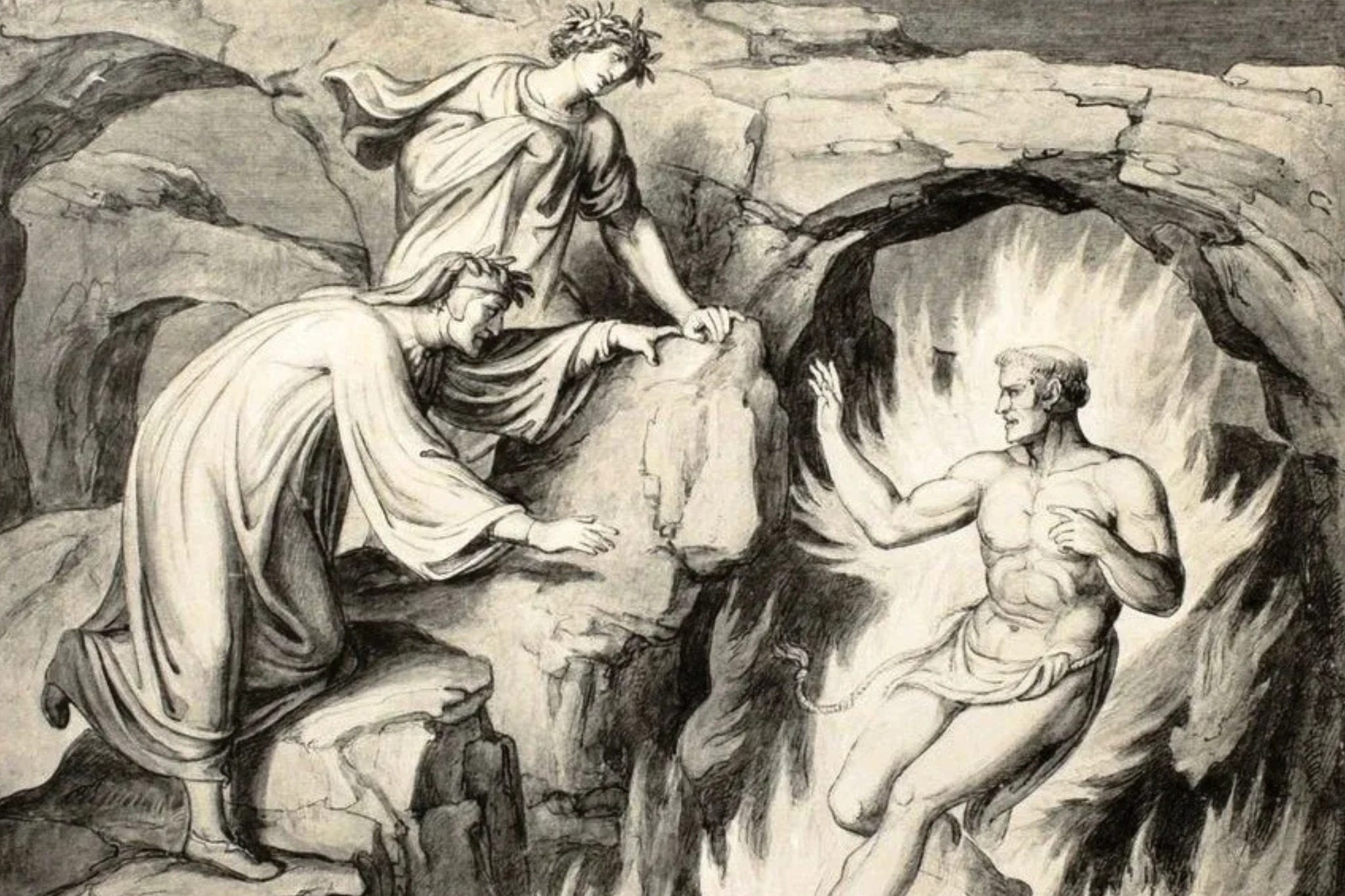
I regret to inform you that I have been seduced by a demon.
Alright, not a demon exactly, but someone who is staying in hell forever.
That someone is Ulysses - Dante’s Ulysses, the one in Canto 26 of the Inferno.
I say “Dante’s Ulysses” because Dante is an extremely audacious fellow who wrote unauthorized sequels and fan fiction about the classics of antiquity and also the Bible. He took it upon himself to write the last chapter of Ulysses’ life, wherein the hero winds up sailing all the way to hell.
I got seduced by Dante’s Ulysses because he gives a very compelling speech. Most people that Dante walks by in the Inferno give speeches, and most of these speeches are bad - soaked with self-pity, self-righteousness, self-justification. Speeches like “Yes, I cheated on my partner, but I was too full of lust NOT to cheat!” Ulysses’ speech isn’t like this - it’s stirring, inspiring, and one that destroyed him and everyone who followed him.
In Dante’s telling, Ulysses grows old but cannot settle down. He whips up his old crew for one last voyage, a voyage into the forbidden and the unknown. They sail past the edge of the world and catch a single glimpse of the sacred afterlife before a tornado from God tears them apart.
We find Ulysses towards the bottom of hell, encased in flames perfectly fitted to his body, with no light to guide him and no heat to warm him but his own. He is in the circle of fraudulent counselors, misleaders, betrayers. Another resident is Guido da Montefeltro, a military strategist turned monk. Pope Boniface VIII came to Guido seeking advice on how to destroy a rival stronghold, promising absolution in advance. Guido’s counsel: falsely promise amnesty, then slaughter them when they surrender
Why is Ulysses next to this guy? “Let’s have one last adventure and dare to discover things” sounds like a great speech, certainly better than “The Pope says I can betray who I want”. We today see knowledge as a good thing in and of itself - Sapere Aude, “Dare to Know”, is how Immanuel Kant characterized the Enlightenment. “To boldly go where no man has gone before” is the motto of the much-beloved Captain Kirk. But for Dante, the problem isn’t the knowledge-seeking itself, nor is it the audacity - it’s that Ulysses doomed his own men. He didn’t venture out to challenge God in a canoe, he went out with a full crew. What’s more, Ulysses was doomed because he was trapped in his identity. He could not not dare. His appetite for experience so great that he could only feed it by sacrificing other lives. He is audacity calcified into compulsion.
What hooked me about Ulysses’ speech is that I recognized myself in what he said. I used to see myself as a daring knowledge-seeker whose daring granted me license to do whatever I wanted. I did not wind up inspiring a crew to sail our ship to hell - I was mostly impulsive, unreliable, and drunk. I drank before meeting up with others to drink. I drank before tests, before work, before dates. I left parties with more alcohol than I arrived with. If I was drunk and you didn’t call me out on it then that made me better than you, because I got away with something. I wasn’t challenging the rules for the sake of universal liberation, I needed the rules for everyone else so that I could enjoy the thrill of transgressing them. I didn’t seek liberation, I sought a self-image of thrilling exception.
Eventually my self-authorizing self-image exhausted itself - at the end, no matter how much I drank, I couldn’t actually feel okay, and nobody trusted me enough for me to get the little thrill of betrayal. I turned beyond myself, beyond my story about myself, for help. I am not a medieval Christian, but Dante’s story is still very much mine.
There’s a tremendous irony here in Dante finger-wagging someone for audaciously self-authorizing. In the book that Dante wrote about his personal guided tour of the afterlife he is endorsed by the greatest poets of all time, he settles every personal score he had in life, he damns living popes to hell, and he makes direct eye contact with God. The one differentiator here is that Dante writes himself as being divinely ordained - his journey is spent following God-sent tour guides, the whole thing happening by sacred commission. Dante is writing about himself in his Ulysses, about what he himself is half doing. Maybe that’s what makes the Inferno honest despite itself - Dante knows the flame he’s describing because he himself is standing in it.
The difference between Ulysses and Dante isn’t that one is audacious and the other is humble. It’s that Dante, in his own story, found someone to follow. He is in conversation with his guides. He learns, he changes, he is open to experience as something that can shape him rather than something to gloriously conquer. In my life I seek that openness every time I sit down in a room full of others and say “Hi, I’m Max and I’m an alcoholic” - my experience is my own, and also contributes to the common identity that we all share in recovery. I inform others and others inform me, and we all orient ourselves towards the common goal of going to bed sober tonight. I reconstruct my self as a self that is open, permeable, accountable, shared.
That’s what I take from this: not to extinguish the fire of self-creation, but to share it.