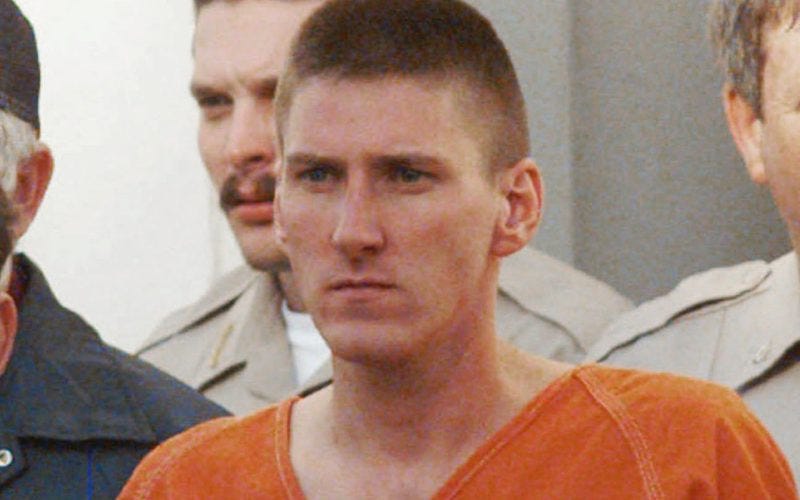
If he were in my generation we would have described Timothy McVeigh as a “burned out former gifted child.” He was genuinely bright and genuinely talented, but as he reached adulthood he didn’t thrive in exactly the way that he thought was his destiny.
Many people, in their own way, have to reckon with the brute fact of failure in their lives. Is something wrong with me? Is something wrong with the world, its institutions, society as a whole? The answer, I think, is “yes and yes.” The challenge is figuring where to put our energies of improvement, how to divide up the responsibility. Many people put the blame of failure entirely on themselves, like cult members who would rather commit suicide than admit that their cult is even possibly wrong. Other people put the blame entirely on society, insisting that the corruption of others is entirely responsible for their every lie, every rejection, every frustration. You can’t personal-virtue your way out of bad laws, and you can’t blame bad laws for the basic temptation to break a promise.
McVeigh was in the second camp, the society-blamers. What made his experience distinct was that his encounter with “bad institutions” happened in the military. He was a talented soldier and, at the beginning, felt like he had a bright future there. Then he was sent to Iraq and saw combat - or rather “combat” in scare quotes - gunning down pathetically outmatched opponents for a “cause” he didn’t understand. More importantly, he was scheduled for a special forces examination, and getting deployed to Iraq meant he didn’t get to train. When he came back and took the physical test, he collapsed. He was double-humiliated: killing people for nothing, feeling tricked into showing up for the test exhausted and looking like an idiot. He quit the military shortly after that.
What McVeigh retained from the military was a willingness to risk his life and take the lives of others. Not just a willingness, an ability. He had discovered that he could be a good soldier, how to face the enemy and pull the trigger without hesitation and without regret. This set him apart from the squishy citizens who never had to worry about killing or fighting for their lives, who couldn’t even imagine what he was capable of. His broken ego returned to the civilian world desperate for distinction, and violence was where he found it.
Many people live through having their self-image shattered, and many people go through the military without committing atrocities when they come home. What made McVeigh who he was, the reason I am writing about him now, was the right-wing gun culture of the 1990s. Specifically, the communities based around gun shows who adopted a profoundly adversarial position against the federal government - people who believed that the government was both evil and incompetent, that where it was good it was useless and where it was evil it was relentless. That’s where McVeigh found himself, where he found his home. The conspiratorial framing gave him a story that worked very well for his wounded pride. He had been deceived, and now his eyes were open. He was naive to have trusted the military, to have almost given them his life. A useless, evil war had deprived him of the training he needed to pass his special forces exam, but that just goes to show that he should never have trusted them in the first place. They threw away his talent, and frankly, he was lucky that they did, because he was better than all of them. He was a super soldier, better even than the ones who passed their special forces exam, because he saw how full of shit they all were.
He might have lived a marginal life of quiet pain and resentment if not for two things: the Waco siege and gun control laws. At Waco, the government laid siege to an apocalyptic cult that had been stockpiling heavy weapons. McVeigh saw this as the government treating its civilians the way he, in the military, had treated the people of Iraq. He drove out to Waco and sat by the road outside the siege perimeter, passing out anti-government bumper stickers and giving news interviews. The Waco compound burned, with people inside. It wasn’t clear who started the fire, but McVeigh blamed the government. The images of the burning compound were, well, seared into him. He once was an enthusiastic participant in state violence, and now he saw it pointed at people like him. Then gun control laws were passed, and he felt like he was under an immediate threat, so he decided to act.
Once McVeigh decided that violent action was a necessary counterattack - an urgent act of self-protection and self-preservation - his subsequent actions can be understood through two things: a book called The Turner Diaries, prevalent in the gun show circuits at the time, and the 1993 World Trade Center bombing.
The Turner Diaries is, to put it mildly, an intensely racist novel about a white nationalist uprising against the federal government. In this book, the federal government is leveraging minority integration and welfare to dilute and destroy white people. The climax of the novel is, appropriately enough, a car bomb detonated at a federal building - the FBI headquarters - which, in the fantasy world of the novel, inaugurates an uprising and puts an end to the new world order. That’s where McVeigh got the idea of bombing a federal building.
The World Trade Center bombing in 1993 was a moving-van bomb, and provided the concrete blueprint for what McVeigh ultimately did. In McVeigh’s eyes the bombing wasn’t a tragedy so much as an instructive failure of design.
The 1993 bombers had succumbed to a kind of theatrical over-engineering. They packed their van with “extras” - hydrogen tanks meant to cause massive fireballs and cyanide precursors intended to gas the survivors. In practice, the hydrogen burned up slowly and the cyanide just went up in smoke. They had attempted a complex and expensive chemical synthesis that left them with nasty burns and a bomb that didn’t topple the towers as intended. McVeigh saw this as amateur hour. They had focused on the style of the destruction rather than the mechanics of the blast.
Timothy McVeigh improved on their design by simplifying it. He stripped away the cinematic flourishes and focused entirely on the explosive yield. No chemical poisons, no fancy fireworks, just barrels of ammonium nitrate and racing fuel arranged to shape the charge for maximum structural damage.
Later, in prison, the psychologist who evaluated him said that it was very bizarre to hear this guy talking about the building of a truck bomb as if it were some sort of science experiment. McVeigh enlisted the help of two other people who shared his views, Fortier and Nichols. He had served with them in the army, but unlike him they now had families. They were not exactly on his level as far as violent action was concerned, what they were ultimately willing to risk. While they did help him in the commission of the act and in securing the materials necessary for it, at the end - right up to the very day of it - McVeigh had to physically threaten them and threaten their families to make them go through with helping him.
I should say here: this is where I truly lose him. Everything before this point I can trace from within - not endorsing it but following it, relating to it as one hurt person to another. I can understand wounded pride, I can understand a narrative that reframes failure as awakening, I can understand seeking a community that provides both belonging and an enemy worthy of one’s talents. But after the bomb goes off, McVeigh becomes something else to me. He stops being a subject I can understand and becomes an object I can only report on. The facts that follow the detonation are interesting, but I’m telling them from the outside now.
I can understand the fuse, but the explosion I can only describe.
The bombing itself, and the aftermath, displays a baffling mix of dark thoughtfulness and care coupled with bizarre carelessness. McVeigh created many false aliases, a common practice for those in the gun show circuit looking to evade federal attention. But he was not always consistent in using them. The night before the bombing he was staying in a motel, and the receptionist asked him a question while he was about to sign his name, and when he looked back down he distractedly signed as himself. Later, he placed an order for Chinese food using a name, delivered to the hotel room that now had his name on it. He planted a getaway car in Oklahoma City and left it there without a license plate. After the bombing, he drove off and never put the license plate back on, so within two hours of the bombing he’d been pulled over and arrested for misdemeanor crimes. He was sitting in a jail cell when federal agents came to him. An axle from the truck used in the bomb had been found with an identification number on it, which they traced to a rental agency in Kansas where he had used one of his fake names. Then they discovered him using that fake name to order Chinese food at a motel where he had signed using his real name. That’s how they were able to connect him to everything. Did he want to get caught?
He claimed that, on some level, yes - he wanted to be caught. He described his whole situation later as a protracted suicide by cop. He wanted to demonstrate that the government was evil, even in its killing of him. He also wanted to exhaust federal resources, having them uselessly chasing after him, trying to put pieces together. Whether or not this is valid is difficult to ascertain. It’s hard to tell how much of this is self-serving mythology, an attempt to paper over the fact that he made a lot of mistakes and got caught in a way that wasn’t exactly on his terms. Or maybe it’s just that he put a ton of thought and energy into the commission of the act itself, and afterward was simply a question mark. He was a soldier who had fulfilled his mission. He himself was a bomb that had been dropped and expended. What happened next to him was of no particular consequence.
His defense was very strange, because he insisted on completely confessing to the defense attorneys and put them in the position of having to prove that he didn’t do something that he did. They didn’t have an alibi for his location because… he committed the act. What he wanted - or what he said that he wanted - was to use the trial as a mouthpiece for his vision. He wanted to make the defense prove to the court that the United States government was evil and violent, and that he had to act as he did in self-defense. They did not do this. He was found guilty, sentenced to death, and executed in 2001.
He died a nerd. He loved sci-fi stuff, all the way to the end. One of his fake names, Bob Kling, evoked Klingons from Star Trek. He described the bombing itself as analogous to Luke Skywalker blowing up the Death Star. Nobody cares about the stormtroopers on the Death Star. Why should you care about federal agents in a federal building? If there’s collateral damage, there’s collateral damage. Why are you waving those pictures of dead kids at me like it’s my fault? What kind of villains would put a daycare on the Death Star?
He was also, genuinely, intelligent. When I was reading about this, I was genuinely impressed, in some ways, that he made the improvements that he did on the World Trade Center bomb. That was a very odd feeling - to read about building a better bomb and to think nice job with that, those improvements make sense. But there it is. He was a smart person, a brilliant engineer in certain ways. And this tragic, calamitous confluence of circumstances led to him committing the greatest act of domestic terrorism that the United States had ever seen.
It’s a valid question, in some ways, to ask whether or not all of this was effective. Not whether or not it was just, but whether or not the bombing did what McVeigh wanted it to do besides kill people at their desks.
Consider the case of the assassin of Archduke Franz Ferdinand, the man who kicked off the dominoes that led to World War I. He wanted an independent Serbia. Did he get it? In a sense, he did. After millions had died, after Yugoslavia arose, after communism - Serbia is, indeed, independent. But we have to ask: was that merely a massive perturbation in an already unstable situation that would have resolved itself in a similar way anyway? Was it worth it for millions to die, for authoritarian communism to rise and fall, for him to get what he wanted?
Similarly here: did Timothy McVeigh get what he wanted out of this?
In a perverse sense, he did. He did dramatically reduce the number of confrontations between the federal government and arch-libertarian militant groups, but this didn’t happen because he was effective in the way he actually wanted to be. This happened because militant groups lost a lot of steam as a direct result of his actions. If he had merely assassinated individuals or blown up an empty building, then he might have been a sympathetic figure. But he massacred a bunch of innocents, and people just did not want to be associated with anything that had to do with him. The federal government did review its policies over things that happened at Waco and other places like Ruby Ridge. But that was already something that was happening anyway. And so whenever confrontations did occur, they were bloodless, almost eventless. They were also much less frequent because, as I said, people just weren’t as excited about doing those things anymore.
Of course, now McVeigh is gone, and we live in a different world. But nevertheless, it is interesting to me how his actions were, in many ways, ruinous to the very things he claimed to hold dear.
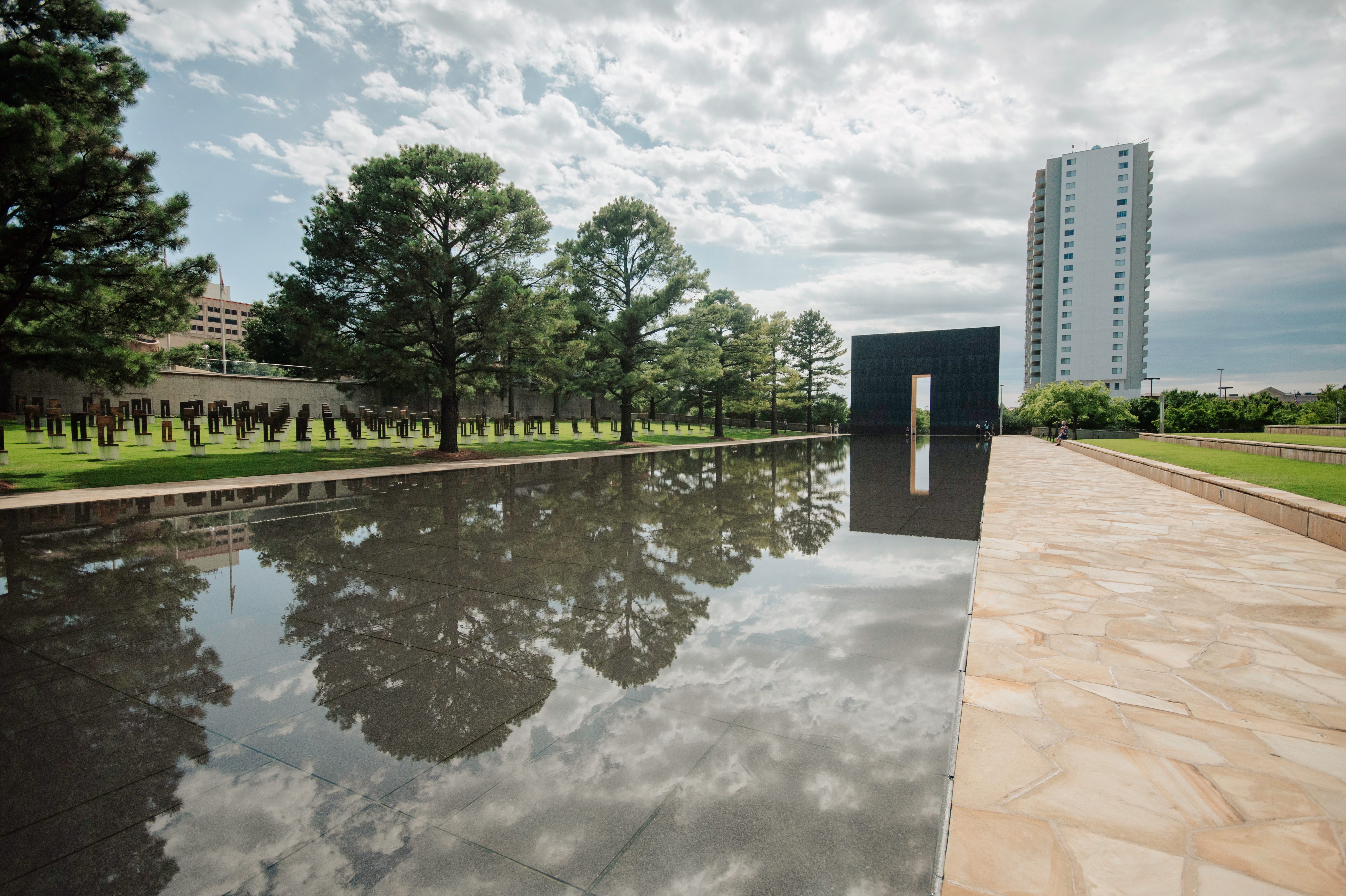
Looking at this man was… not easy. I did this because I visited the Oklahoma City bombing memorial and was profoundly moved by all of the stories that were there. To date myself, April 19th 1995 was a day that I spent in elementary school. The museum at the memorial took you back to that day, and as I walked through the exhibits I found myself in rooms that looked the way things looked when I was a child. And then those childhood rooms were destroyed, and I felt my own childhood re-evoked and destroyed with them. Connecting with the event, and with the man behind it, has been my own way of processing that experience.
I do not want to claim that McVeigh’s story is the most important or vivid or interesting one. There are many, many, many others - stories of resilience, of loss, of survivorship, and indeed, of grace. Looking at any of them requires looking at all of them. It also requires looking at ourselves.
It requires looking at Timothy McVeigh not as a monster, but as a human, because that’s what he was. He was not cut from a particularly different cloth. His pain is understandable. His trajectory was preventable. It is something that could, in a sense, happen to any of us. His extraordinary cruelty was born in a pain that was terribly, terribly ordinary.
Whenever we look at these things, the important thing is to look at what we don’t want to see, including those parts of ourselves that can be understood through this person. It is important to look at the hurt, the insecurity, the loneliness, the high energy with nowhere to go, the wounded ego, the fallen pride.
All of it is us.
I am him and he is me. I am the lit fuse two minutes away from the target. I am the truck cabin filling with fuse smoke. I am the stinging eyes and racing heart stuck at the longest stoplight ever. I am the relief when the light turns green. I am the click of the key in the lock as I shut the truck door for the last time. I am the slow and controlled walk away from a bomb just about to blow up. I am the mission. I am the willingness to shoot the bomb and die if I have to. I am the earplugs nobody else on the street is wearing. I am blocks away when the ground shifts away beneath me. I am the buildings rocking like blades of grass in the wind. I am the glass shattering into so many points of light. For a moment, for no longer than a heartbeat, with my feet off the ground I finally, finally feel lighter than air.
And then… nothing. The explosion severs whatever thread connected us. I can find him understandable right up until he brought that kind of death into the world. Whatever came after I can only observe from the outside.
May it remain that way forever.