

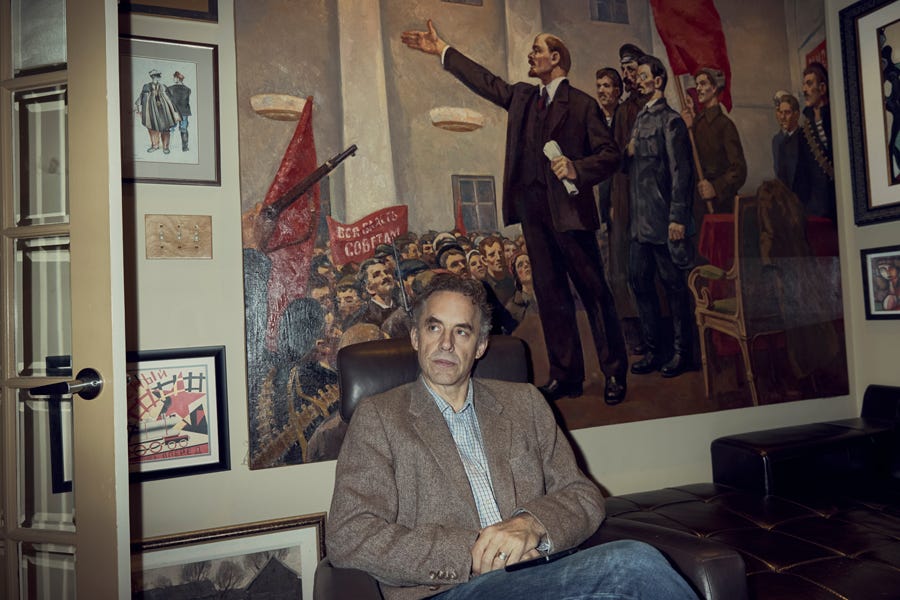
Let me share with you a certain voice in my head, a voice which leaves me feeling profoundly alone in the places where I feel most at home. It’s a voice that’s difficult to silence because, in certain ways, it helped me.
The voice in question belongs to Jordan Peterson. It isn’t literally his voice, but he spoke and I listened and kept on speaking his voice to myself.
The voice in question is also a listening, a seeing, an understanding—a new and important game to play. The way to win this game is to see yourself and every left-wing thing as being hopelessly full of shit.
When I was younger I played a different game - one where every right-wing thing was hopelessly full of shit. Right-wing things emanated from something hidden, something evil, something it was my job to uncover and call out. Right-wing things were expressions of: capitalism, colonialism, patriarchy, racism, stupidity, cruelty. All right-wing assertions, even right-wing people themselves, were subject to instant dismissal. I didn’t argue with them, I diagnosed them, if I thought about them at all. I was, I thought, very clever and very good at this game.
The underlying reality, such as it is, proved to be more complicated than I originally thought. My totalizing suspicion started to sputter as experiences and ideas came my way that did not neatly fit into the old picture. That’s where I found Peterson, or rather where he found me: he taught me a totalizing suspicion of my old totalizing suspicion. He didn’t bring me relief. He merely suggested I switch targets.
The voice I still bear, the voice he spoke, has this to say: leftism, at its core, is an expression of terminal immaturity.
“Immaturity” means that you are constituted by impulsivity and self-centeredness, a constitution that is the natural state of a child but which is the shameful state of an adult. The left, in this view, is a snarl of childlike entitlement and appetite. Desires and individual selfhood are all that there is - the highest values, the only things that can confer value in the first place. Leftists worship “authenticity” and “self-expression” because the self is all that there is. If it feels good, if it boosts your self-esteem, then do it. No God will judge you. None of it matters in the end.
Just as teens rebel against their parents, leftists rebel against tradition. Everyone to ever live before you is full of shit, because they lived before you. The past is a graveyard of ignorance and bigotry, because it is the past. Your era is the only important one, because it’s yours. You have no duty to approximate some mind-independent truth. You can assert whatever you want.
Socialism is just the hatred of hard work baked into a story where everything that doesn’t make you feel good is part of an evil conspiracy. Leftism is the game of finding sophisticated-sounding noises to dominate other people and take their money. And hidden behind all this self-worship is self-hatred - you hate yourself because you are not God even though you try to be. You hate everything that created you. You hate your family, your country. You hate God so much that you try to pretend that He doesn’t exist.
Maturity, then, consists of shaking all of this off. Maturity means caring about something that is not you - your faith, your family, your country. Your weakness and suffering come because you are not God, but you do not have to be. Accept your duty. Embrace self-sacrifice. Seek the enduring, the eternal, the transcendent. Youthful rebellion has its place, testing the limits of the order. But growing up means admitting that the order has survived your challenge, and taking your rightful place in its preservation.
That’s the voice in my head. It bubbles up every time I see anything political. It’s instant. What corruption is this expressing? Probably immaturity. The game to win is to see these expressions for what they are: disgusting, destructive, corrosive to the people making them.
It’s weird because it’s not me. But it helped me. And that’s exactly what makes it so hard to dislodge.
Why did I keep speaking it after it was spoken to me? Because there’s a seductive coherence to it. And do I have to admit to you that the voice got me good because part of it was true. I learned the hard way, through my drinking, that “feeling good immediately and forever” has a lot of drawbacks. In getting sober I sought and developed resilience, commitment to the success of others, integrity in my word. My lived experience taught me that vacant appetite makes for a poor master. So when Peterson’s voice said that leftism was just entitled craving dressed up in theory, something in me recognized what he was describing.
What ever parts of it are true, as a whole it becomes a trap, because from within the framework it is unfalsifiable. Any critique of tradition becomes evidence of immaturity. Any demand for justice becomes disguised appetite. If you disagree, shame on you - that’s just proof you haven’t grown up yet.
Here is what the voice cannot see: Orlando, my hometown, has a street literally named Division Street. It was named in the Jim Crow era to separate the black part of town from the white. When it came time to build highways, they built them through the black neighborhoods, where residents were too poor and too black to matter in the eyes of the state. The injustice is monumental, enduring. I see it every time I look out my window.
The Peterson voice has no vocabulary for this. Its entire grammar reduces social phenomena to individual psychology. If black communities are struggling, the voice can only say: immature, entitled, lacking in personal responsibility. It literally cannot perceive that a highway routed through a neighborhood continues to shape wealth, health, and opportunity for generations. Structures are invisible to it, which means that a vast domain of human suffering is invisible to it too.
This is the specific failure: the framework cannot distinguish between individual appetite and collective grievance rooted in documented history. It flattens everything. A trust-fund kid demanding the right to skip his midterms and a community demanding that their children not be poisoned by industrial runoff become, in this voice, identical phenomena. Both are just entitlement. Both are immaturity.
It’s a dark irony, then, that this trumpeting of maturity merely collapses into its own evasion.
And yet I can’t simply reinstall my old game, the one where every right-wing thing is evil. That game had its weaknesses, and I left it for a reason. It can’t unsee the ways that grievance can calcify into identity, the ways that victimhood can become its own kind of appetite. Both games are, to put it bluntly, scapegoat machines. One sacrifices tradition, the other sacrifices the dispossessed, but both generate meaning through contempt. Both give you someone to blame, someone whose existence explains your suffering.
The problem isn’t that each game has claim to some of the truth and we just have to find balance. The problem is that both games are the same game: the game of total suspicion, where you win by unmasking the hidden corruption behind your enemy’s vacant lies.
What would it mean to stop playing?
…I don’t fully know. But I think it has something to do with surprise. Real engagement with another person, or a tradition, or an institution, means being changed by the encounter. It means holding your interpretive frameworks loosely enough that something you didn’t expect can genuinely surprise you.
That’s where I try to live now, in the space where I can be surprised, where the other person might not be reducible to however I diagnose them. It’s uncomfortable, and it offers none of the satisfactions of the blame game. But it’s the only place I’ve found where something like understanding becomes possible.
I don’t know if that’s maturity, but I’m pretty sure it’s closer than anything Peterson taught me.
Great thoughts, Max. Completely agree - it’s the same thing. I think it also helps to decouple right-wing with conservative and leftist with liberal. Also, generally, to stop reducing ourselves to labels that will always be incomplete. Our lives are finite but our cognition is vast. I don’t want to be any label. I want to be myself and free to learn and grow and change my mind. That’s freedom.