

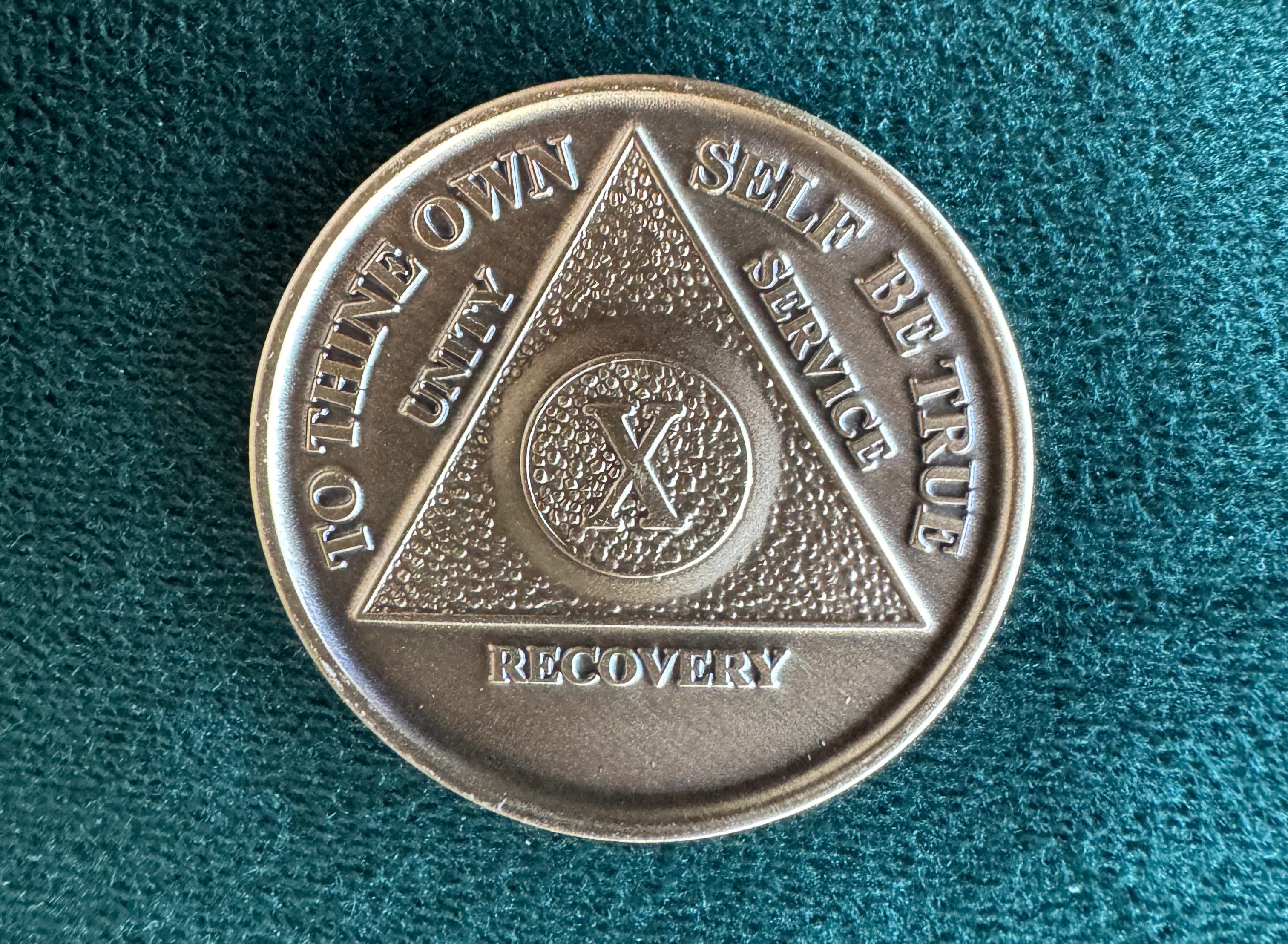
The rooms of recovery are full of Shakespeare. One line, mostly: “to thine own self be true,” stamped on the medallions people hand out at anniversaries. That lovely line is lifted from the mouth of Polonius, a babbling liar who spends his play scheming and deceiving. He dies while eavesdropping, put down by a random sword Hamlet thrusts through a curtain.
I’m not writing about that line, as much as I’d like to. I’m writing about a different little phrase that has a lot of life in recovery rooms, “One Day At A Time”. It is not from Shakespeare, but it does remind me of another very-famous Shakespeare line. Unlike the scoundrel Polonius, this line doesn’t even try to be affirmative.
Here it is. We’re in Act 5 of “Macbeth” and Macbeth has just been informed that his wife is dead and he has something to say about it.
She should have died hereafter;
There would have been a time for such a word.
Tomorrow, and tomorrow, and tomorrow,
Creeps in this petty pace from day to day,
To the last syllable of recorded time;
And all our yesterdays have lighted fools
The way to dusty death.
And a few lines later, the part everybody knows:
a tale told by an idiot, full of sound and fury, signifying nothing.
What I want to argue is that this isn’t just an expression of despair or nihilism or grief. It’s a vision of a human life once you’ve crushed the future into a completely-predictable shape.
Macbeth’s crushing calculation
Macbeth brings his world to ruin thanks to what he did with a prophecy.
“Hereafter” is the play’s word for the promised future. It’s how the witches greet him in the first act:
All hail, Macbeth, that shalt be king hereafter.
At first he is open to whatever happens, saying
If chance will have me king, why, chance may crown me
Without my stir.
His wife, though, wants his stir right now. Lady Macbeth wants to secure the future immediately.
I feel now the future in the instant
she says as she goads him towards stabbing a man in his sleep. If he had been open to the future, ready to receive it as a sort of gift, we would be watching a different play. His attempt to solve the problem of the future ruined that very future.
Macbeth’s grasp at mastery turned every moment into a vacant unit of transit. “Now” is something that is in between you and where you want to go. What you want isn’t here, it’s there, in the future. The only “now” that could ever matter is the “now” in the future where you have succeeded, the “hereafter” yet to come.
So then Macbeth, at the very end of his life, has nowhere left put his grief. He can’t feel it now, since now is meaningless. He has to put that grief into one of those infinitely-vacant tomorrows that stand between him and… what? What is he even doing anymore? What future does he have to look forward to?
No matter, though. The man looking ahead to infinite meaningless tomorrows had an afternoon left, tops.
A new way to look at Time
“One Day At A Time” is basically the opposite of this nasty stance that Macbeth has.
AA calls upon you to live the entirety of your life within the horizon of a single day, living each day as it comes. Where Macbeth saw time as an endless pile of raw material, AA calls upon its members to completely let go of any final feeling of prediction and control beyond what’s immediately in front of you. You are not responsible for solving tomorrow’s problems today. You don’t have to figure out today how you’re going to spend the rest of your life sober. You just have to go to bed sober today.
Macbeth, as I see it, wanted that final certainty about what the future would look like. The curse wasn’t that it was impossible to get - the curse was that he got it.
Saint Paul and Non-Saint Heidegger
AA and Shakespeare are both products of the West, and for most of two thousand years the West has had one big event in its future: the return of Jesus Christ. Ever since he said he’d be back people have been scrambling for some sort of Macbethian certainty about exactly when this end of time would happen.
The Apostle Paul says that nobody knows when this promised return will happen. In his words, Christ comes like a “thief in the night.” To state something hopefully obvious: a thief who announces himself is not a thief! The whole structure of the most sacred promise in the Christian story is one that cannot be put on a calendar.
What the philosopher Heidegger noticed about this is that Paul refuses to answer the “when is this guy Jesus coming back” question at all. He asks a new question instead: how will you live while you wait? What if the waiting isn’t a delay between you and the thing, what if the waiting is actually the thing?
The waiting is what structures your entire relationship with time. Towards the end of his career, Heidegger’s word for the posture was Gelassenheit, usually clunkily-translated as “releasement”. Gelassenheit is a letting-be of things, an openness to the world disclosing itself on its own terms.
The Protestant relationship to time is intense
Martin Luther, the spark of the Protestant Reformation and in many ways the father of Modernity, called reason “the devil’s whore”. Scholastic philosophy and the long conversation of church tradition were discarded, leaving the individual with a direct line to God. The Bible was now up to everyone to interpret, and anyone could now pronounce on Revelation or Daniel. People took a Macbethian crack at calculating the exact date of the apocalypse, and (at least so far) every time they’ve been wrong.
The thief in the night, somehow, became a date on a calendar. Every individual now has a direct path to the end of history itself, each with a personal role to play in the critical moment that is upon us at last.
What the actual difference is
I’m going to summarize the overly-neat line that divides these approaches to time, then throw it away.
The overly-neat question is this: is the future something that you are required to generate or something that you are only ever able to receive?
Macbeth generates. The prophecy hands him a future and he takes personal responsibility for forcing said future to come true.
The date-setters generate. Christ’s return becomes a project with a timeline and a personal power play: we alive today have been chosen to personally summon God. God’s been sitting there on the bench waiting for us to tag Him in.
Paul receives. AA receives. That’s what the slogan is doing. Not “the future doesn’t matter” but “the future isn’t yours to figure out immediately and force into shape.”
That said: the generate/receive line is illuminating and clean and also is not what has actually served my life.
The complication, which is also Heidegger
Heidegger, unfortunately, was on the losing side of World War 2. His later Gelassenheit is in many ways the resigned sigh of someone who lost. I’m glad that he did, and I’m sorry that his politics were as bad as politics can get.
I’m double sorry because, for me, the earlier part of his life was way more insightful. I’m attracted to the stuff he wrote in the 1920s. Being and Time, his magnum opus, brought us Entschlossenheit, roughly “resoluteness”, along with a separation between expecting and anticipating a future.
Heidegger lands with anticipating as the way to go. Anticipating holds the future open as a possibility, something that calls you forward without ever somehow becoming a thing-among-things that you yourself possess. Expecting treats the future as a given, a package already on its way to you, and invites you to refresh the tracking page over and over again.
So, to kind of spit in my own earlier face, Macbeth’s problem isn’t “too much resolve” and AA’s virtue isn’t “tranquil openness”. I think Macbeth’s problem is that he traded a future of power for power over the future. I think AA’s calls people to be very much resolved, just resolved over the right thing - staying sober no matter what.
It comes down to this, I think: outcome vs posture. Macbeth forced an outcome with disastrous results. AA invites a posture of unconditional openness - you can’t put a price tag on staying sober, saying “I’ll only stay sober if nothing bad happens to me”. Neither can you decide ahead of time what gifts will come your way.
What this means for me
What I am advocating for is not to diminish ambition - not giving up on a better world or a better life for yourself. What I’m advocating for is this: take the stand and decline the guarantee. More directly, see that a guarantee was never possible and never necessary in the first place.
When I first got sober I was absolutely terrified of the future - I didn’t know how to stay sober on a normal day, much less stay sober during the mountain of ups and downs the future would surely have in store for me. It turned out that I didn’t have to know how to do it to do it. I just had to stand for the possibility of one sober day, without a guaranteed algorithm for how, and then do it again in the morning.
If there’s one thing that ten sober years has shown me, it’s that hereafter can wait.