

I know what it’s like to live inside a closed loop. I built one for myself out of books, intelligence, and alcohol - a self-authorizing system in which every failure became proof of my tragic genius and every rejection became proof that nobody understood me. The loop is a structure of meaning-making that feeds on itself: I am special, therefore my suffering is meaningful, therefore I am special. It is airtight, it is simple, it is lethal.
I got out of it. My loop collapsed under the sheer cumulative weight of its own failures, and one day I could no longer explain away the wreckage. I couldn’t sound smart enough to myself to outrun what I had become. The person - the identity - sustained by the loop died so that I could live, and I have spent the better part of a decade learning to live without who I used to be while still remembering him as a possibility.
David Koresh never got out.
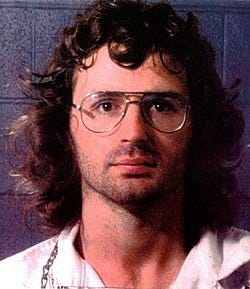
Vernon Wayne Howell was born to a fourteen-year-old girl named Bonnie Sue Clark. Thirty-one years later he was reborn as David Koresh, legally changing his name to reflect his true nature as literally a Biblical character. Two years after that, at age thirty-three, David Koresh died, surrounded by dozens of burning corpses, many of them children.
When he was Vernon Howell, he was a stupid child, an unloved child. Young Bonnie fell in with one bad man after another, all of them violent towards her and her son. Vernon was dyslexic and had to be put in special classes and got called all kinds of names. He was sexually assaulted, at least once. For him the entire world was pain, and everyone who was supposed to take care of him had failed him.
Vernon, though, had a gift, a critical gift, a sacred gift. He could barely read, but he could memorize. He could memorize books better than anyone else. And so he memorized the Bible.
I had my own version of this gift. I read voraciously, not just to learn but to arm myself. I accumulated references the way Koresh accumulated weapons, as proof of some sort of special destiny. I could quote studies, reference theories, win arguments - at least, I thought I did. I was building a version of myself that was licensed by intelligence the way Koresh was licensed by God. Our loops were built from different materials - his from scripture, mine from secular intellect - but the architecture was identical.
For much of Western history the Bible was taken as a conversation-stopping authority. You quoted Bible verses to prove your point. Much of the West doesn’t do this anymore, but many communities still do, and Vernon found them. He could quote the Bible to justify just about anything he wanted, and he did.
What made Vernon Howell into David Koresh was exactly this move, interpreting the Bible to justify his will and desires. Most people’s encounter with religion is completely different. Many people read the Bible to clarify their desires, to purify bad desires, to orient themselves towards God. Others reject the Bible and religious authority in general as arbitrary repression, seeing their individual desires as vital and self-authorizing. Koresh found a third way, a strange sort of recursive kink in the structure of meaning-making. He didn’t subordinate his desires to religion nor did he subordinate religion to his desires — he declared that his desires and religion were one and the same.
This is the loop in its purest form. I am God’s prophet, which means my desires are God’s desires, which means everything I do is righteous, which confirms that I am God’s prophet. It’s a closed system, airtight, impervious to outside correction. Every challenge becomes further proof. Every failure becomes a test of faith. My version ran a different program - I am a genius, which means my suffering is meaningful, which means the world is too stupid for me, which confirms that I am a genius - but the operating system was the same.
Vernon Howell read the Bible so intensely that he thought that it was about him. Don Quixote read chivalric romances until he went insane, and Vernon did that with scripture. He saw himself in the book of Revelation, as the Lamb of God, uniquely ordained by God himself to interpret scripture and open the Seven Seals. This meant that he alone could interpret the word of God. He saw himself as like Cyrus, a sinful human ordained by God to destroy Babylon. “Koresh” is another way to say “Cyrus”, hence his new name. He was ordained in his sinful nature, which meant that he could partake fully in sin. He could have sex, and he did. He saw himself as like David, as like a king in the Bible with his concubines. He saw himself as creating the 24 lords to sit on their thrones in the end times, as prophesied. He saw all marriages as nullified, except those to him. To follow Koresh was to offer yourself to him fully, to offer him your family as his family. All women became his women, all children became his children. The law of man may have had something to say about the “age of consent”, but Koresh could show you that the law of God gave him the right and indeed the duty to father as many of these prophesied children as possible as soon as possible, so if your girl could get pregnant then he was certainly going to try.
He got his group from a pre-existing splinter sect of the Seventh Day Adventist church, the Branch Davidians. Most Christian traditions believe that revelation concluded with Jesus and the apostles, that the Bible is complete. The Branch Davidians believed that prophecy is an ongoing thing, that God gives some living contemporary humans the gift of interpreting the Bible and revealing truths that until now had been sealed. Lois Roden was the prophetess of the Branch Davidians, in her sixties. Vernon Howell joined her group when he was in his twenties and went about seducing her.
They never wound up having a miracle baby. When she died a succession crisis broke out between Vernon and her son, George. The prophetic succession resolved itself the way these things often do, not through divine revelation but through one claimant being slightly less unhinged than the other. George Roden challenged Vernon to a resurrection contest, digging up a corpse and telling Vernon to bring the body back to life. Vernon reported him for corpse abuse, and when the cops asked for proof Vernon and his followers went to the compound with a camera and guns, and a shootout occurred. Vernon was charged and acquitted - I guess that’s Texas for you - and wound up inheriting the compounds anyway after George Roden was institutionalized for murdering an unrelated man with an axe.
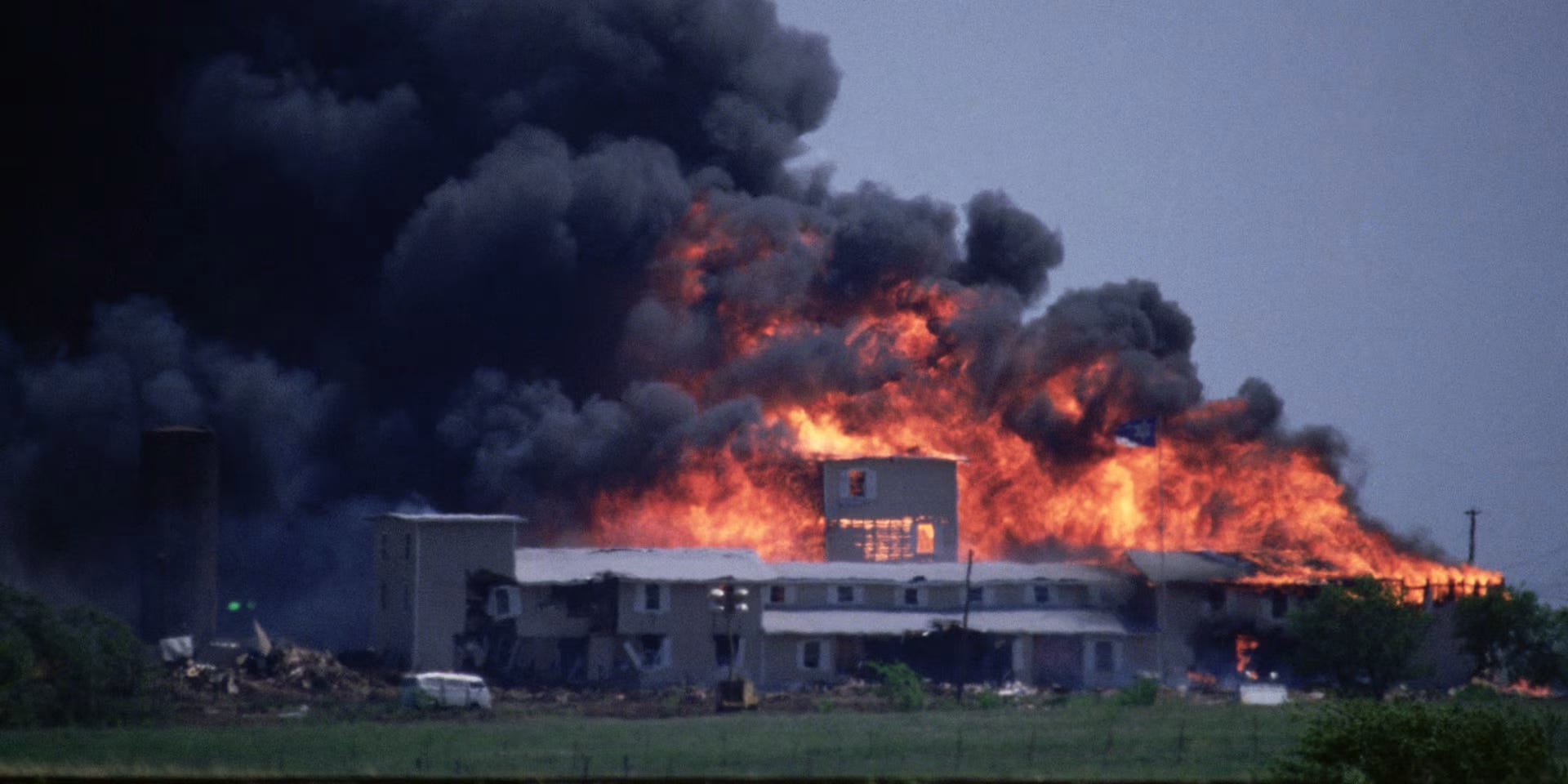
Vernon took control of the Mount Carmel compound and rebuilt it, and himself. He took the name Koresh. He built a structure made of plywood and cheap materials, not because they couldn’t afford better but because better wasn’t necessary. The apocalypse was coming. Why pour a concrete foundation for a building that wouldn’t need to outlast the Seventh Seal? The compound was built the way you build something when you sincerely believe that the world is about to end - functional, fast, temporary. Every wall was a confession of faith.
Inside those plywood walls, Koresh was stockpiling weapons. This was Texas in the early 1990s, and gun culture was not exactly unusual, but Koresh’s operation went well beyond a few rifles and some survivalist enthusiasm. He was accumulating assault weapons, converting semi-automatics to full auto, buying grenades and grenade components. When a UPS driver noticed a package bound for the compound had broken open and spilled grenade hulls, he reported it. That report made its way to the Bureau of Alcohol, Tobacco, and Firearms, the ATF, who began investigating him.
They learned about the polygamy, the statutory rape. They learned his habits. They knew he jogged. They knew he went into town. They could have arrested him any day of the week, alone, on a road, without incident. They chose not to. What they chose instead was Operation Showtime.
That was the actual name. “Operation Showtime”. The ATF was an agency under political pressure, struggling for relevance and funding, and what they wanted was a visible, dramatic, undeniable win. They wanted cameras. They wanted a raid. They wanted the world to celebrate their victory. They tipped off a local news cameraman who drove out to the compound ahead of the tactical teams and, finding himself lost, stopped to ask a man for directions. The man he asked was a Branch Davidian. When the ATF arrived, guns drawn, Koresh and his followers were waiting.
What ensued was the biggest gun battle on US soil since the Civil War. Four ATF agents and six Branch Davidians died. Koresh was wounded. The raid was a catastrophe, and the catastrophe was born directly from the same impulse that kept the cult going. The ATF needed Operation Showtime the way Koresh needed the Seven Seals. Both were playing for an audience that would validate their existence.
I recognize this too. In my drinking days, every social situation was a performance - an opportunity to out-think and out-drink everybody in the room. Like Koresh, like the ATF, I conflated spectacle with substance. Koresh could have quietly healed his childhood wounds. The ATF could have made a quiet arrest. I could have had a quiet life. But rather than quiet the loop wants confirmation, and confirmation requires witnesses.
After the failed raid, a siege settled in and the FBI took over negotiations. And to their credit, the FBI negotiators made a genuine, sustained, good-faith effort to resolve the standoff peacefully. They were professionals. They understood hostage situations. They had protocols, strategies, experience refined over decades of crisis management. They talked to Koresh for hours, for days, for weeks. They made concessions. They got people out, including some children.
But the negotiation was doomed, and it was doomed for two reasons that had nothing to do with the negotiators’ goodness or skill.
The first reason was the ATF. Four of their agents were dead. Their raid had very publicly failed. The institutional ego of the ATF demanded that the standoff end in a way that demonstrated overwhelming federal authority, that justified the raid in retrospect. Every patient day of negotiation was a day that the ATF’s failure sat unresolved. The tactical teams on the perimeter grew more aggressive as the siege dragged on. They blasted music and sounds of animals being slaughtered at the compound through the night. They crushed the Davidians’ cars with tanks. Every escalation undercut what the negotiators were trying to build. The FBI’s own people later described it as one hand extending an olive branch while the other made a fist.
The second reason was Koresh himself, and this is the deeper problem, the one that hits me harder. The FBI negotiators were operating from within modernity. They understood the world in terms of rational self-interest, legal consequence, psychological need. They could model a desperate man bargaining for his freedom. They could model a con artist stalling for time. What they could not model was a man who genuinely believed he was living inside the Book of Revelation.
Koresh was not stalling. He was not bargaining. He was waiting for God to tell him what to do. When the FBI offered him a deal - come out, face trial, tell your story to the world - they were offering him something that made perfect sense within their framework and no sense at all within his. A trial in a federal courthouse was a scene from someone else’s story. His story ended with the Seals, with fire and judgment. He told the negotiators he would come out after he finished writing his interpretation of the Seven Seals. The FBI thought this was a stalling tactic. It probably wasn’t. He probably meant it. But it didn’t matter either way, because the two sides weren’t having the same conversation. They were speaking across a gap that no amount of good faith could bridge. The FBI was negotiating from the Enlightenment. Koresh was negotiating from Revelation. Neither could live in the other’s world.
After fifty-one days, the FBI moved in with tear gas. CS gas, delivered by tanks punching holes in the plywood walls. The plan was to make the compound uninhabitable and force the Davidians out. Within hours, the compound was on fire.
The truth is that you pump flammable gas into a flammable building full of people who believe the world is ending, and what happens next is not a mystery. A fire started. Was it the flammable gas finding a lantern? Suicidal arson by the Davidians?
Seventy-six people died, including twenty-five children. David Koresh died. The compound burned to its foundations, which, being plywood, didn’t take long.
Martin Heidegger, a favorite philosopher of mine, talked about “thrownness” - Geworfenheit - and it matters here because it reframes the tragedy entirely. We are all “thrown” into life into circumstances we didn’t choose - our parents, our birthday, our country, our era, etc. Throwness is even deeper than that -It’s the claim that those conditions are constitutive, that there is no self hiding underneath them waiting to be liberated. Your self is inextricable from the world you were born into. There was no secret Vernon underneath Koresh who could have broken free if only he’d tried harder or been offered the right deal. The abandoned child, the sacred gift of memorization, the communities that treated the Bible as the final word on everything - none of these were obstacles between Koresh and his real self. They were his self. The loop wasn’t something he was trapped in. The loop was him, all the way down.
That’s what makes it a tragedy and not merely a horror story. Koresh was too good at the one thing his world gave him. He was so good at it that no failure, no confrontation, no fifty-one-day siege could crack the loop. The worse things got, the more the loop confirmed itself. The ATF’s aggression proved the government was Babylon. The siege proved the end times were at hand. The fire proved that he was the Lamb.
In my life, my thrownness, I held on for too long because I felt like to give up my identity was to stop being me, to die. And in a sense, it was. When my loop broke, I experienced something that I can only describe as a kind of death, because the person who had been sustained by the loop could not survive without it. The person I was had to die for me, today, to live.
But at least I had other tools. I had people who loved me in ways that, however imperfectly, reached me. I had a world that offered alternative stories about who I could be. I had, if nothing else, the sheer biological fact that alcohol was destroying my body in ways that even my loop could not reframe as glamorous. Koresh’s world offered none of this. His community existed to confirm him. His body was the Lamb’s body. Every possible exit from the loop had been sealed shut by the loop itself.
I’m grateful to have survived. I don’t say that lightly, and I don’t say it to congratulate myself. I say it because survival was not a choice I made but a grace I received, a collapse I couldn’t prevent. The community and connection I now have - the people who knew me when I was still stuck in myself, who waited for me on the other side - has proven to be the best kind of afterlife I could have hoped for.
But when I look at Koresh, I don’t just see myself. I see the people who couldn’t leave. I see the women who handed their marriages and their bodies to a man who had made God into a mirror. I see the men who surrendered their families because the loop was eloquent and the alternative was exile. And I see the children - the twenty-five children who died in that fire who never had the chance to build a self that wasn’t already enclosed in someone else’s narcissism. They were born, they lived, and they died inside Koresh’s story about himself. Their story ended with his, and they never had a chance to even know that “no” was possible.
That’s the thing about these loops - they don’t just consume the person inside them. They consume everyone and every relationship nearby. My drinking didn’t just hurt me - it hurt people who loved me, people who hadn’t signed up for my mythology of tragic brilliance. But then I got to make amends, start new conversations, re-introduce myself outside of myself, however imperfectly. Koresh’s people never did. They burned with him.
I look at the burning compound and see what loops become when they cannot break. I look at Koresh and I see my self, my old self, a possible self still, a self trapped in itself. I see, with a recognition that I wish I didn’t have, exactly how it feels to live inside a story that is burning down around you and to mistake that heat and light for proof that you were right.